Signs it's time for a new furnace
If your furnace is more than 15 years old, it's a good time to start considering replacement. Age aside, watch for these signs:
- Your furnace needs frequent repairs
- Energy bills are going up even though usage hasn't changed
- Rooms heat unevenly — some hotter or colder than others
- The furnace cycles on and off more often than it used to
- Your home is starting to have humidity problems
- The furnace has become noisy, or rattles, buzzes or hums
- It's putting out excessive dust, soot, dirt or rust particles
- You see rust around the furnace, or components show cracks or corrosion
Choosing the right furnace
The right furnace isn't the biggest one. It's the one sized to your home's heating load. We work that out from your home's size, insulation, windows and layout rather than copying the rating on the old unit, since many older homes have been renovated, re-insulated or re-windowed since their furnace went in. An oversized furnace short-cycles, wears out sooner and leaves rooms uneven. An undersized one can't keep up on the coldest nights.
Beyond size, the biggest choice is how the furnace burns its gas:
Single-stage
Runs at full output whenever it's on. The simplest and lowest-cost option, and fine for many smaller homes.
Two-stage
Runs at a lower output most of the time and switches to high only when it's really cold. Quieter, with more even temperatures.
Modulating
Adjusts its output in small steps to match exactly what the house needs. The most comfortable and efficient option, at a higher price.
Most new furnaces also use variable-speed (ECM) blower motors, which use far less electricity than older blowers and move air more gently and quietly. We'll walk you through the trade-offs and recommend what makes sense for your home and budget.
What a furnace installation includes
- Free in-home assessment and written quote
- Heating-load sizing for your home
- Gas permit and inspection
- Removal and disposal of the old furnace
- New PVC venting for high-efficiency furnaces
- Condensate drain connection
- Gas piping and shut-off valve to code
- Ductwork connections and transitions
- New thermostat, if needed
- Combustion test and startup
- Walkthrough of your new furnace and filter
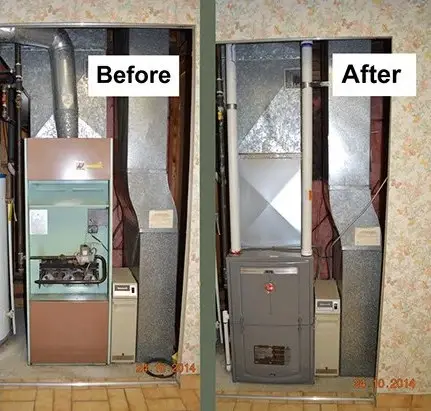
One detail that's often missed: when an old furnace that shared a chimney with a gas water heater is replaced by a high-efficiency model vented through PVC, the water heater can be left alone in a chimney that's now too large for it. We check for this on every job and correct the venting where needed.
High-efficiency furnaces may qualify for utility or government rebates. Programs change often, so ask us what's currently available when we visit.